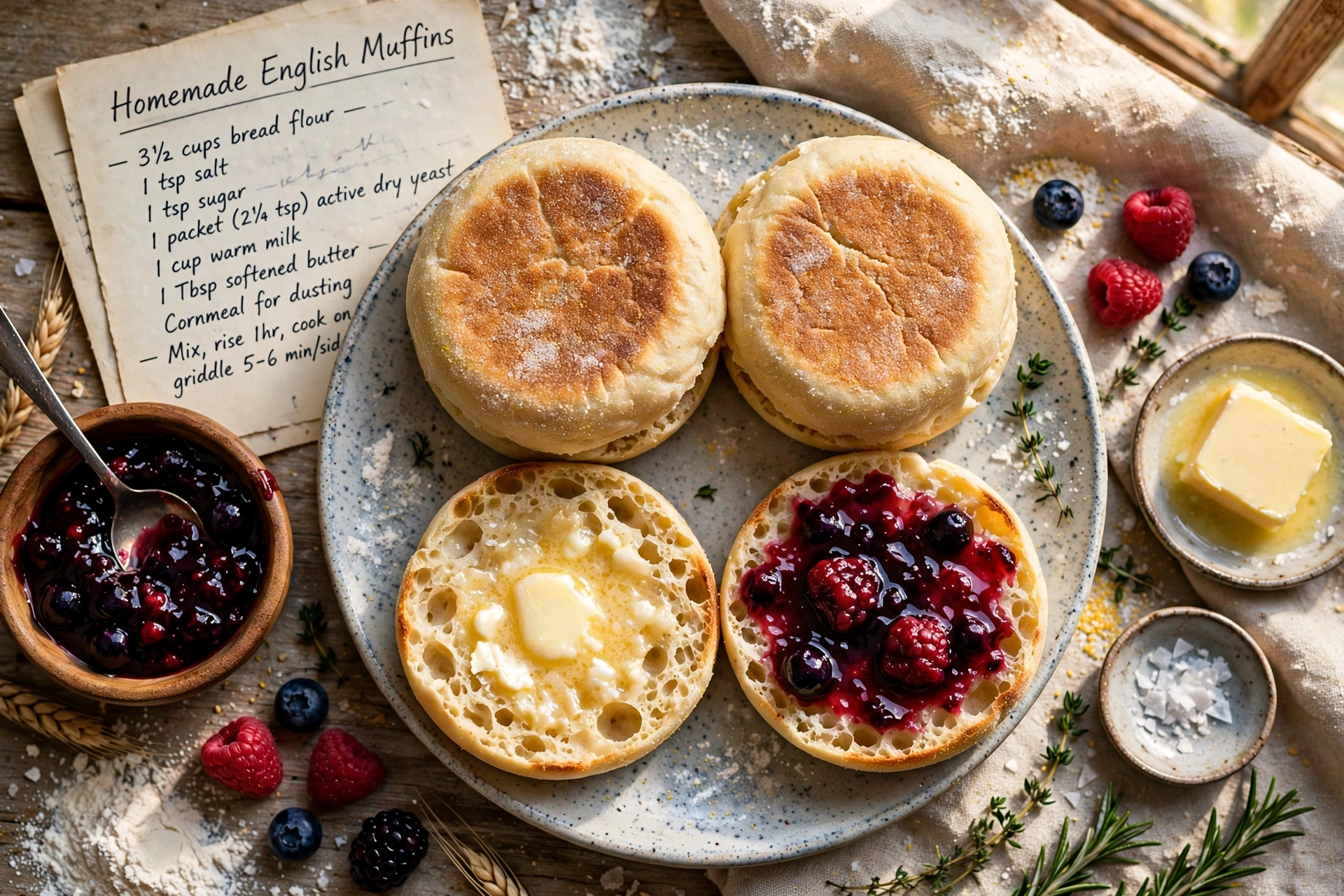
Homemade English Muffins
Fluffy, nook-and-cranny-filled homemade English muffins made completely from scratch on the stovetop, perfect for breakfast sandwiches or slathered with butter and jam.

The Best Homemade English Muffins, Made From Scratch
There is something deeply satisfying about pulling apart a warm English muffin and seeing all those famous nooks and crannies staring back at you, ready to soak up melted butter. If you have only ever known English muffins from a plastic bag at the grocery store, this recipe is going to be a revelation. These are cooked entirely on the stovetop, no oven required, and they come together with simple pantry staples you probably already have on hand.
This is one of those foods from scratch recipes that feels a little bit magical the first time you make it. Flour, yeast, buttermilk, and a hot skillet are really all it takes. Whether you are searching for fresh flour recipes to put your baking hobby to good use, or you just want a reliable recipe for homemade English muffins that actually works, this one delivers every time.
Before we get cooking, the right tools and ingredients make a real difference here. A sturdy stand mixer takes the guesswork out of kneading, a proper biscuit cutter gives you clean, even rounds, and a heavy-bottomed skillet is what creates that golden, slightly craggy crust without scorching the outside before the inside cooks through. These are the products that genuinely help this recipe shine:
Why Buttermilk Makes All the Difference
This is one of those recipes that include buttermilk for a good reason. The gentle tang of buttermilk does more than add flavor. It tenderizes the gluten in the dough, giving the muffins that classic soft, slightly chewy crumb, and it helps create the airy pockets that make English muffins so perfect for toasting. If you are used to an English muffin recipe no milk version, you will notice right away how much richer and more flavorful this buttermilk version tastes.
Chef's Tip: Warm your buttermilk gently before mixing. Cold liquid straight from the fridge can slow down the yeast, so aim for lukewarm, around body temperature, for the fastest and most even rise.
From Mixer to Skillet: How These Come Together
Unlike a traditional loaf, these muffins do not go anywhere near the oven. After the dough rises once, you pat it out, cut it into rounds, let it puff up a second time on a bed of cornmeal, then cook each one low and slow in a dry skillet. The low heat is the real secret here. It gives the inside time to cook through fully while the outside develops that deep golden color instead of burning.
This method also happens to work wonderfully if you love from scratch breakfast recipes that feel like a weekend project but do not actually take all day. Most of the time here is hands-off rising time, so you can prep coffee, set the table, or just enjoy your kitchen smelling like a bakery while the dough does its thing.
If you have a bread machine and were originally searching for an English muffin recipe for bread machine use, you can absolutely let your machine handle the mixing and first rise on the dough cycle, then pick up this recipe at the shaping step.
Chef's Tip: Resist the urge to press down on the muffins while they cook. Let them rise gently in the pan undisturbed so you do not deflate all those beautiful air pockets you worked hard to create.
Ready to Make Them?
Some home bakers affectionately call these their "oh my gosh muffins" the first time they split one open and see the crumb. There is genuinely nothing like the moment a homemade English muffin comes off the griddle. Ready to make it? Here is the full step-by-step recipe:
Homemade English Muffins
Fluffy, nook-and-cranny-filled homemade English muffins made completely from scratch on the stovetop, perfect for breakfast sandwiches or slathered with butter and jam.
Ingredients
- 3 1/2 cups all-purpose flour, plus more for dusting
- 2 tbsp granulated sugar
- 2 1/4 tsp instant yeast, one standard packet
- 1 tsp salt
- 1 cup buttermilk, warmed to lukewarm
- 3/8 cup water, lukewarm
- 3 tbsp unsalted butter, melted and slightly cooled
- 1/4 cup cornmeal, for dusting
Instruction
In the bowl of a stand mixer, whisk together the flour, sugar, instant yeast, and salt.
Add the warm buttermilk, water, and melted butter. Mix with the dough hook on low speed until a shaggy dough forms, then knead for 6 to 8 minutes until smooth and elastic.
Shape the dough into a ball, place it in a lightly greased bowl, cover, and let rise in a warm spot for about 1 hour, until doubled in size.
Turn the dough out onto a lightly floured surface and pat it into a disc about 1/2 inch thick. Cut into rounds using a 3-inch biscuit cutter, rerolling scraps as needed.
Sprinkle a baking sheet generously with cornmeal. Place the muffin rounds on top, dust the tops with more cornmeal, cover loosely, and let rise for 30 to 45 minutes until puffy.
Heat a large skillet or griddle over low to medium-low heat. Do not grease it.
Carefully transfer the muffins to the skillet, working in batches. Cook for 7 to 9 minutes per side, until golden brown and cooked through, adjusting heat as needed to prevent burning.
Let the muffins cool slightly on a wire rack before splitting with a fork to reveal the nooks and crannies.
Toast and serve with butter, jam, or use for breakfast sandwiches.
Equipment
- Stand mixer with dough hook
- 3-inch biscuit cutter
- Large skillet or griddle
- Baking sheet
- Wire cooling rack
Notes
Serving, Storing, and Variations
Split these with a fork rather than a knife. It sounds fussy, but forking them open along the natural seams is what preserves all those irregular pockets that make English muffins so good at holding butter and jam. A quick toast afterward crisps up the outside beautifully.
A few ideas for using them:
- Classic breakfast sandwiches with egg, cheese, and your favorite breakfast meat
- Mini pizzas topped with sauce, cheese, and toppings, broiled until bubbly
- Simply toasted with salted butter and a drizzle of honey
These muffins freeze exceptionally well, so consider doubling the batch. Cool them completely, split them, and freeze in a bag with parchment between layers. You can toast them straight from frozen whenever a craving hits, no thawing required.
Once you have made a batch of these from scratch, it is hard to go back to store-bought. They are softer, more flavorful, and genuinely fun to make once you get the rhythm down.